Monday, May 6, 2013

Letters of Albert Liscom - Part 2


I finished transcribing the letters of Albert Liscom, Company C, 13th Mass Vols.  I took digital pictures of the original letters held in the collection of the Carlisle PA Army Archive, when I visited there in July 2012.

I've numbered 73 letters.  (Albert's son claimed there were 91 letters in the collection, so some appear to be missing).  There are about 3 or 4  more letters in the collection that are not written by Albert. Two are written by his Aunt Eliza, one by an Uncle William, one by a soldier named Frank, also in Co. C, (which describes the battle of Bolivar Heights) and an unknown note to 'father' dated 1857, signed Jacob.

One or two of the letters are incomplete, letters and a couple of letter scraps still need to be placed.

I have learned a great deal more about Albert and his family since my previous post about the letters.

His father, Levi was a piano maker who had years of experience making quality instruments with a New Hampshire firm called Dearborn Bros.  Mr Liscom was considering going on his own during the early war period, and Albert occasionally comments on his prospects.  The firm of Dearborn and Liscom was eventually formed.  I found a few items relating to the company along with a picture of one piano bearing the company name.  Albert's father was successful in his business venture and continued making fine pianos for many years.

Surprisingly, the letters with the most important information were the most difficult to transcribe. 

Consider this one.  He wrote over the top of the first page, but once I got to know Albert's hand, and his writing style, I was able to transcribe the faded words underneath, although it took persistence (& photoshop to adjust the contrast).  Of course it turns out to be one of the better letters in the collection.  He is writing from Front Royal about the failed Union  attempt to corner Stonewall Jackson in the Shenandoah Valley in 1862.  Here's what it says underneath the cross writing:

Front Royal
Dear Parents & Sister
          I now take the first opportunity since we left Manassas to write to you for I suppose you are  beginning/starting  to wonder why you did not hear from me.  We left Manassas the next day after I wrote you from there and since that time we have been on the march continually not stopping more than one night [?] in  a place, we have been on[?] some[?] of the roughest  roads I ever saw.  part of the time we marched on the rail road (Saturday) [?] and part of the time on the dirt road and on what
p2
might perhaps be called roads if the bottoms of them in some places had not fallen through.  When we left Manassas, we started on an expedition to try and cut-off Jacksons force and we have been pulled and hauled round among these mountains ever since but as yet our division have not had a chance at him yet...
This letter continues to describe some of the hardships of the campaign and to express contempt for the leadership of General McDowell the division commander.

I have also learned that Albert, had some serious health conditions. I stated in the first post on his letters that he was trying to get an honorable discharge from the service in the fall and winter of 1862, and that he would have done anything short of desert to get it.  I have since discovered a long letter to his father, written from Waterloo, VA, July 19, in which he describes some of his ailments:

" For a long time my teeth have troubled me a great deal.  I find it impossible to live on army rations.  I have to live on such light stuff as I can buy or cobble up myself and it is rather surprising to me how I live on what little I eat, about all we have for rations is hard bread & coffeee for breakfast & supper, for dinner we have salt junk boiled fresh beef or fried beef and once in a great while baked or stewed beans, very often there is no dinner at all, this is the way we live day after day.  I have long ago given up trying to eat salt junk, boiled beef I cannot
p9
eat, and the beef steak I do the best I can with to get the juice and You may ask what I live on, well I hardly know myself.  Corn starch, rice molasses cakes, crackers & cheese, stuff that does not amount to much except to take away the money very fast without warranting good health to follow.  I have got about discouraged trying to live in such a way, my teeth are so far gone that I can hardly bite off a piece of soft bread.  There is not two teeth in my head that I can use, that come square together.  the only tooth that is of any service to me in biting, I expect every day will break off, it is more than half gone now, it is the one next to the eye tooth on the right side.  I cannot chew at all on the left side, my teeth are all broken off even with my
p10
gums from the left side including the eye tooth and following round to the one next the eye tooth - (which has a large cavity in it) on the right side, there is nothing but the hollow stump)  The two teeth running back from the eye tooth on my left side are more than half decayed in fact I have not a whole tooth on my upper jaw.  I have not had any drawn out, all that I have lost - have broken off.  Do you wonder at my feeling hungry?"
In spite of all this, at the time Albert was insisting he wished to do his part honorably in the army.  His big complaint was that his division was kept out of the fighting.

"Last Spring when we crossed the river we expected ...that we were soon to meet the enemy and take our part in the struggle.  But how has it been ?  If that old sesesh Gen Abercrombie had not disobeyed orders, we should have been in that battle at Winchester. And then again if we had been with Gen Banks, where we belong, when he retreated from Winchester, we should have met the enemy there, for Gen Banks said in his speech the other evening that if our brigade had been with him, he would have stood Jackson until reinforcements had arrived.  But for all this we should have met Jackson at Front Royal if McDowell had not avoided it.  And thus it has been, marching from place to place, with nothing but the monotony of camp life."

(The reference to Abercrombie and Banks refer to March, 1862 when several regiments were remomved from Gen. N. P. Banks army, and placed  under command of Gen. John Abercrombie.  Gen. Hartsuff took command of the brigade in May)

These excerpts describe his health condition and discouraged morale. He seems to have had some kind of malnutrition or immune problems.   A few weeks later getting water for the company, he banged a canteen on his knee.  The knee bothered him so much he went lame.  He couldn't keep up during the hard marches of Gen. Pope's retreat..  He eventually fell out of the ranks in mid - August and went to a hospital in Washington.  His teeth continued to deteriorate, and his 'rheumatism' never healed completely.  Knowing he couldn't stand the harsh conditions of a winter campaign or camp he pressed for a discharge.  He eventually got it in mid 1863.

I'll post a bit more on the letters again.


Wednesday, May 1, 2013

April 30th 1863, 150 Years Ago


     April 30th 1863 was a memorable day, not in a good way, for the 13th Mass.   General Joseph Hooker's army made a flanking march around the Confederate Army entrenched at Fredericksburg.  With 3 Corps, Hooker went north, west, then south, crossing the Rappahannock and Rapidan Rivers to get a good position to strike at the Confederate line.

     The 1st Corps and 6th Corps were left behind, opposite Fredericksburg, to divert the enemy's attention while the flank march was underway.  The 13th were in the 1st Corps.  John S. Fay recorded in his memoirs:


"The Rebels had artillery in position on the hills about a mile and a quarter back from the river, from which they was trying to shell us but they did not succeed in getting range of us.  It commenced raining in the afternoon and continued to rain at intervals during the night and most of the next day.  The rebels would try to shell us every hour or two, but without effect until about three o’clock in the afternoon, when they succeeded in getting range upon us with a battery of twenty pound guns. About two o’clock a dispatch was read to us from Gen. Hooker stating that he had succeeded in crossing the river at United States Ford…We now knew that our movement was only a feign to draw the rebels down the river from the fords above us.  Gen. Hooker’s dispatch was received with great cheering which so provoked the rebels that they opened a vigorous artillery fire upon us, and advanced their infantry and commenced to skirmish with the first division [across the river]. Our division was en mass, so if a shell fell among us it must hit somebody."

Then it happened, at about 15 minutes past 5 p.m.  George Henry Hill of Company B, recorded it in a letter  to his parents:


"My last letter was written opposite Fredericksburg.  About an hour after it was written the Rebels opened upon us with shell and after firing about a dozen which went over our heads one burst in our regiment killing Capt. Bush & Lieut Cordwell and wounding Corpl Fay of Co F.  They were all sitting just in front of [me] when two of us were playing chess and the brains of Lieut Cordwell scattered all over us.  his head was taken off.   A hairs bredth more elevation and we would have received the benefit of it"

Captain George Bush, Company F, pictured right, had just returned to the regiment from Boston and was giving the men some news when he was struck by the shell in the side.  He died a few moments later.

   Sgt. Enoch C. Pierce who was standing nearby used handkerchiefs to tie a tight tourniquet around Fay's arm using a stick from the shattered rifle to twist it tight until the bleeding stopped.  He did the same for Fay's leg.  Then Pierce and private Andrew J. Mann, carried Fay up a hill behind their lines to the division field hospital.   (Enoch C. Pierce, Pictured).


Fay wrote:

 "When they was carrying me to the hospital, I was satisfied that my leg and arm would have to be amputated, after they got me there and the doctors told me so I requested that Dr. A.W. Whitney of my Regiment should perform the operation. After waiting a few minutes for him to get through with another patient that he was at work upon when they carried me in.  They gave me chloroform and that was the last  that I knew until about half past  eight when I came out of the effects of it and found my right hand and right leg amputated."


Pictured is the Fitzhugh House, formerly Sherwood Forest, the estate of a prominent local resident used as a Field Hospital opposite Fredericksburg in 1863.  Surgeon Allston Whitney of the 13th Mass. had charge of the hospital.  It was here that Fay's two limbs were amputated in one of the front rooms.  Pictured below is the center hall of the mansion.  Photo was copied from the .Spotsylvania Civil War Blog


Fay would survive the trauma, with the dubious distinction of being the most seriously maimed man from the regiment, but his ordeal was not over.  The hospital was captured when the Union Army moved north during the Gettysburg Campaign.  Those that could be evacuated to safety in Washington were moved, but those still recovering  from serious wounds were not.   While still recovering from 2 amputations, Fay would have to endure several weeks captivity at infamous Libby Prison in Richmond.  Dr. Whitney would not abandon his patients and was also incarcerated at Libby - for 4 months.

 The 13th Mass. were again lucky, during the week that followed the shelling.  They were not heavily engaged in the Chancellorsville battles, which were even bloodier than Fredericksburg.  Samuel S. Carleton was killed May 4, and 6 others were wounded during an afternoon reconaissance.

The men  suffered from the usual exposure and had a fatiguing 22 mile march to the front, but in this way it was not unlike some of their other experiences in other campaigns.  One might wonder if April 30th was not the most  memorable event of the campaign for the veterans of the 13th Mass.  Especially since Fay lived a long life and was active in post war regimental activities.


Friday, March 8, 2013

Winter Camp, 1863


     The lack of posts here at the blog is due to the relentless effort to finish the latest page of my website.  I'm proud to say that new page is up; an undertaking that took 4 months of continuous work.  There are 113 images, including 28 pictures of '13th Mass' guys on the new page.  Hopefully most readers don't have 'dial up.'   This page breaks new ground.

     It is the first 'detail' page of the website for the year 1863.   There are significantly fewer primary sources left to tell the soldiers' story in their own words. Fortunately with the help of descendants, collectors, national park archives, museums, & historical societies I've pulled together an impressive number of un-published materials to continue with descriptions of the soldiers' life in camp around Belle Plain Landing, Virginia, in the harsh winter months of January, February & March. 


     Morale was at a low ebb.    Mud swallowed up what was left of it, along with the rest of the army, during General Burnside's disastrous 'Mud March' campaign.  Desertions became frequent.   Harsh winds & snow made picket duty even more unpleasant than usual.  Still the soldiers endured, as the letters attest.

     I'm pleased to have permission from the Pearce Museum, Navarro College, Texas to post transcriptions of of two letters from their collections.  The museum relies in part on income it gets providing copies of these transcriptions to researchers. It is very generous of them to allow me to share Charles Leland's letters.  Nineteen year old Charles writes his father about morale and desertions in the Army under Burnside's leadership.  The Pearce Museum has other holdings related to the '13th Mass' including the 1863 diary of John Boudwin, Co. A, some letters of John Fox, 2nd Mass. Vols, brother of Lt. Charles B. Fox, and 11 letters of Oliver H. Walker, who transferred to the 24th Mass., from the 13th, in Dec. 1861.  Check out their site here:  Pearce Museum.

     In December I received several materials from the collections in the Massachusetts Historical Society.  Some of these are on the new page, including a few witty letters of Charles Adams, Company  A, of Dorchester, who gained fame in the post war years with a series of German-Dialect poems and verses published under the pseudonym 'Little Yawcob Strauss.'  Adam's fondness for word play shows up in letters to his various siblings. 

     In one of his letters, Charles mentions a sea-shanty song, popular in the states in the 1860's.  A little research revealed the title of the 'Bow Wow Wow' song to be "Boston Harbor."  A link to a version of the song performed on YouTube adds a musical dimension to the history of the regiment.

     The letters of Dennis G. Walker, and George Henry Hill are not to be missed, both provided by family descendants.  Those of you with problems spelling, will appreciate Walker's unique disregard to the discipline.      George Hill gets a box from home and carefully describes all its contents in a letter of acknowledgement to his favorite aunt.

     A very rare photo of Dennis G. Walker is provided by another descendant, whose ancestor kept a large scrapbook of photos of his 13th Mass comrades. A few other impossible to find images from the same source are included on the new page.

     As usual private John B. Noyes describes everything he sees around him when he returns to the camp of the 13th, in February, 1863, the first to get back after recovering from wounds at Antietam.  Noyes takes us along on picket duty during a snow storm, outlining his responsibilities and that of the squad commander.  Then he takes us on a long trek through the muddy camps of the Army of the Potomac, scattered about Belle Plain Landing and Falmouth, VA, to the Headquarters of new commander General Joe Hooker.  Noyes accepted a position as clerk at Provost Marshall General Marsena Patrick's Headquarters in March.  The position gives him a broader perspective with which to comment on the condition of the Army of the Potomac as it prepares for the coming Spring Campaigns, and he does.

     I always try to sprinkle every page with some humor if possible.  In this case two stand alone articles do the job.  "Grins," by Clarence Bell recalls incidents of camp life which caused the soldiers to smile, pay-day and mail call being the most prominent.  Regimental Historian Charles E. Davis, Jr. uses his customary satire to caricature some of the less soldierly fellows found within the ranks of the 13th Mass, in the article 'Shirks.'

     Letters and commentary by the usual gang, Austin Stearns, Sam Webster, & Warren Freeman fill out the narrative.

     Here is the link, Winter Camp.

     Enjoy the new page.

Wednesday, January 23, 2013

Letters of Albert Liscom, Co. C

"Boston, Mass., September 1, 1921

To the Members of the Thirteenth Massachusetts Regiment Association:

...The last meeting was held at Young's Hotel, September 17th, 1920, with twenty-three members of the regiment and eighteen sons and others present,...

...Charles S. Liscom, of the sons, gave us an interesting talk, and then read a number of letters written by his father, Albert M. Liscom of Company C, during the years 1861-2.
      A copy of the son's letter to me under date of September 12, 1920, which appears in this circular, refers to these letters and their contents.  Limited space forbids printing the letters, even though Comrade Liscom kindly offered to curtail the stories somewhat.
[excerpt]

Dedham, Mass., Sept. 12, '20
Comrade Swan:     I am reminded of a former offer of mine to prepare something relative to the part taken by the 13th at Bolivar Heights and Dam No. 5, and the rather lively engagements there in October and December, 1861.  The history of the 13th does not give any details of these scraps, but in a way I think they were of some importance, for those engaged got probably their earliest training and experience in real battle conditions during these fights and gave the enemy something to chew over.

...My father seems to have been quite a letter writer and sent frequent and newsy letters home, with much attention to detail.  He sent home some 91 letters in all, from Aug. 6, 1861 to Jan. 25, 1863, although the latter part of the time he was confined in hospitals, due to breakdown in health in 1862, just before 2nd Bull Run Battle."  Charles S. Liscom.
It was from the above correspondence printed in the 13th Regiment Association Circulars, that I first learned of the existence of the Albert Liscom Letters.  Today these letters are part of the military archives collection at the Army Heritage Education Center in Carlisle, PA.  I discovered the letters around 2001.  It was not until last summer, that I finally got the chance to visit Carlisle, and make digital photos of the "13th Mass" materials in the archive.

 I started transcribing the Liscom letters in October.  They are a bit tricky.
Albert's cursive is very fine, and most of the letters are written in pencil almost too light to see.  Digital technology gives me the benefit of darkening the letters in photoshop for better copies, but its still a chore.  I was very excited to get this material, because in the early part of the war, Company C, had a different itinerary from the other 9 companies in the regiment, and this is the only source of information I have at the soldiers' level. I recently learned from another source, (the letters of Elliot C. Pierce, from the Mass. Historical Society,) that,

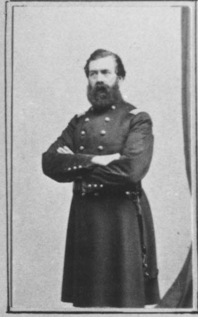
 "Capt Kurtz of Co C. stationed at Frederick is the one that broke up the Maryland Legislature taking 18 prisoners you see the 13th is at work"  [Captain John Kurtz, pictured.  He soon left the 13th for a Lt. Col.'s commission in the 23rd Mass. Vols.]
Unfortunately, most of the letters I transcribed so far, are from the latter part of Albert's service, and as his son Charles wrote, "the  latter part of the time he was confined in hospitals."

Albert left the regiment two weeks before the battle of 2nd Bull Run.  The hard campaigning had left him lame.  He checked into a hospital, and it seems his health never improved.  He could get around okay, and made frequent forays to the city of Washington  (disguised in civilian clothes so he could escape the dreary hospital)  but his endurance was gone, and he really was unfit for duty.  October 29, 1862, he wrote home:

"I went down town yesterday morning with Mrs Brown we got back about two O’ck. And had dinner.  After which I was anxious to go down town again it was so pleasant...

...I wanted To go to some place of amusement.   I went to the Avenue House and found Mrs Goff and a young lady with her a Miss Thomas from Dedham Mass a very agreeable young lady.   They said they would be pleased to go.    So we four went together to Graves Theatre To see Miss Lucille Weston play Lucretia Borgia – the after piece was the loan of a lover.  We had a fine time.   Got back to the Hotel between eleven & twelve."
He spent most of this time actively trying to get a discharge from the army, which did not arrive until late June, 1863.  By January of that year, his long absence induced his officers to report him a deserter:
"Learn by your letters – that I have been mistrusted as a deserter – as soon as I read your letter I sat down and wrote to Lt. Livermore – giving an account of myself – and this morning I got the Dr to add a line certifying that I was regularly admitted here as a patient.   I requested an answer to know if my explanation was satisfactory.   - but I suppose my long silence has given rise to suspicions that I had sloped – but I think my letter with the Drs signature will quiet all suspicion."
 It is apparent from his letters however, he did not wish to go back to the regiment, and would do anything short of desert to get out of the army.

I've been transcribing the letters in reverse order, as that is how they were photographed.  I've completed the letters from May '62 to Jan '63, but there is little new information for me in these. I finally jumped ahead (or backwards if you please) and found some  of the earlier letters to transcribe, but only got to 3 of them before setting this project aside.  I was pleased to find a few references to the popular Color Sergeant Roland Morris, (KIA at Gettysburg) within these letters, but I was getting little else in return for the effort it took to do each letter transcription. (I've transcribed over 100 pages and have at least as many to go).

Oddly enough there is an interesting account about the Oct. 1861 "Battle of Bolivar Heights," in the collection, but it seems to be written by someone other than Albert !

I will return to Albert's letters one day, but I'm currently concentrating on the period of Jan - April 1863, for the website.  I ordered a series of letters from the Massachusetts Historical Society which arrived around Christmas, and I gave them priority.  These include several  letters of Charles F. Adams, Company A, (about 14 letters, Aug. '62 - July '64) and materials that belonged to  Major Elliot C. Pierce, of the field & staff, (Sept '61 - Sept. '63) I will post about these next.

Here is the Bolivar Heights letter, which was probably not written by Albert:


Harpers Ferry Va Oct 18th

                                                My own dear faithful Maria,
                                                                        Since I last
Wrote you Marie I have been through a fight of 7 hours & escaped unharmed.  Early Wednesday morning before we had eat our? breakfast news came that our outposts had been driven in by a large force of the enemy.

 I swallowed my breakfast as speedily as possible I started with about 600 men in the field but only 200 or 300 were in the thickest of the fight & our comp’y were exposed all the tjme so their bullets from their rifles & their shells & cannon balls from their batteries & they had 2 batteries  1 on Loudon Heights across

P2

Shenandoah & 1 right front of us of 2 or 3 guns 1 of which we captured.    When we first advanced they opened their fire upon us with their rifles & it was terrific & not being supported we had to fall back under cover of the houses   We had orders to advance again the bullets fell around us like hailstones over us beside of us at our feet & the way they whistled through the air was astonishing  & our boys kept advancing under cover of everything they could find & at last we got into a brick house & determined to hold it at all hazards befor we all got into the house 1 of the Wisconsin boys got hit in the heart & died instantly   I was very near him when he fell

P3

    He died instantly & the expression on his face was so mild that one that did not know couldint tell whether he was dead or asleep   he had 3 other brothers in the field.  The Wisconsins lost 4 killed, & 5 wounded & 1 taken prisoner  (he was wounded)  Co C had 2 wounded  1 shot through the arm & 1 slightly in the foot it is the greatest miricle that a great many of our Com were not Killed as we were in the thickest of the fight all the time & the many, many narrow escapes that our boys had makes us all think that it was the hand of Providence who preserved our lives   1had a bullet go through his cap  1 through anothers pants 1 struck an others rifle & 1 passed through our Lieut (Jackson’s) [pictured right, Lt. William Jackson, CO. C.  Because of his gallant actions at Bolivar Heights the regiment named their camp at Williamsport, Md. "Camp Jackson" in his honor.]

P4

Revolver case   Your Frank had them strike all around him but was not hit at all   Oh Marie you cannot form even an idea of the feelings when in battle  I did have the least fear but seemed as if I wanted to fly right at them & pay them for Killing & wounding our men   But thanks to our Commander Lieut Jackson (who I am happy to say proved him self a man of good judgement & bravery & who thought a great deal of the lives of his men) we did’t?  be come rash or wild but kept cool & maintained our position  Why the Wisconsin boys had so many Killed was they were ordered to advance to near their batteries  by their Capt & then had to advance & were cut off by their cavalry & 2

P5

 of their men were not only Killed but their bodies were stripped of almost all their clothing & their dead bodies mutilated.    Well Maria to go on with my account of the battle when we got into the brick house we thought we would be able to hold it but Maria we found our mistake for they began to fire their shells at it.  We then fell back amid a shower of bullets to the town &  our Col  (Col Geary of the Penn 28th ) told us not to advance again but to hold our position until we could get a cannon across the river so there we staid exposed to the fire of their shot & shell from their rifle cannon for about 2 hours we?

p6

when they were shelling us But dearest Maria none of us were killed & we all were surprised when we heard that such was the fact how thankful we felt & we all say that it was miraculous none of our company were killed.  (The Paymaster is here now & paid us off this morning)  Well we held our hard fought fort until about 11 O’K at night when Col Geary gave orders to retreat as he had heard that Gen Johnston was advancing with a large army    we crossed the river & you may believe that when we got here we were about tired enough to sleep all of our troops did not get across until about morning.  We achieved a glorious victory Maria & although the

p7

enemy had about 2000 or 3000 men we drove them off & besides they had 2 batteries.  Col Geary said he never saw a harder fought battle & he has been in some 12 or 15 battles.  We expect the enemy will try & drive us away from across  the river   they may be able but I doubt it.  Thankful for our preservation & hoping for a letter from you soon darling I remain your own true soldier boy.

Franklin????


Friday, December 28, 2012

Semper Fi Fund

    
     I've been wanting to post about the Semper Fi Fund since Remembrance Day in November.

      I research the 13th Massachusetts Volunteer Infantry because I am interested in the personal stories of the men that did the fighting during the war.   One of my goals is to make their deeds and sacrifices known, so they can be remembered.  Each soldier has a story.  Those guys are all gone now, but there are veterans around now that we can still remember and even assist, and a good way to do that is by donating to the Semper Fi Fund.

Click the link to learn more.

Semper Fi Fund

     The fund gives direct assistance to wounded marines and their families.  I believe they also assist wounded soldiers in other branches of the service.  The organization has some ridiculously high percentage [94% +]  that goes right to work helping the wounded veterans, instead of being used up in overhead fees.   Many of these wounded soldiers have lost limbs from IED's, improvised explosive devices.  This is a most effective way to show appreciation to  the men and women of our armed forces.   I donated in November, and I hope all who come across this post will do the same.  REALLY - Remember the veterans' sacrifices!  Check out their site and donate.

     And a Happy 1863 to everybody ! 

Wednesday, December 5, 2012

150th Commemoration of the Battle of Fredericksburg

     This is just a short - quick - hurried - & late post -- to write about the coming events planned for the commemoration of the 150th Anniversary of the Battle of Fredericksburg. 

   I wish I could be in Virginia this weekend for the sponsored events.   You can read about the activities here.    Fire on the Rappahannock

     I am particularly sad that I won't be present for the events planned December 9th   "A Nation Remembers"


A friend of mine was involved with a group that constructed two pontoon boats for the re-creation of the river crossing.  Here's a picture of the boats under construction.


     Union Artillery could not drive away William E. Barksdale's Mississippians. whose fire prevented Union Engineers from completing their pontoon bridge opposite the town.  In frustration soldiers of the 7th Michigan rowed across the river in 3 pontoon boats and stormed the opposite shore to establish a bridgehead.  The Confederates fell back into the town.  More Union troops crossed, then followed the Rebels into the town where bloody street fighting ensued. 

Artist Thure de Thulstrup, did this painting  --  One of my favorites of Civil War art.

My friend and his group that built the boats will be re-enacting the event.

 The 13th Mass. Vols did not cross the river here, and their river crossing was un-opposed.  They later fought on the Union Left on what is called the Slaughter Pen Farm.  They acted as skirmishers for the Grand Left Division, as I wrote in an earlier post.  A Confederate encampment is going to occupy the part of the ground during the commemorative activities.

So, if you're lucky enough to live close by please go!  There are more than a few unique aspects of this tragic battle, which will be re-created memorialized and remembered.

I close with a picture of the completed pontoon boat that my friend shared with me.    I'm so used to looking at sepia toned photos and b&w images that I  had no idea the boats were green.  After I received the pictures I noticed they were green in the painting!


Sunday, November 4, 2012

The 13th Mass at the Battle of Fredericksburg

My new web page is up, about the 13th Mass at the Battle of Fredericksburg, December 11 - 15, 1862. 

My website is Thirteenth Massachusetts Volunteers.

Since I began building my website history of the 13th Mass Vols, many Civil War blogs have become prominent.  I started this blog to promote the website.  The website, not this blog, contains the orderly detailed history of the regiment.

Here is the link to the new page.  Battle of Fredericksburg.

N.M. Putnam
The 13th Mass acted as skirmishers during the battle for General William B. Franklin's Left Grand Division.  They were in General Nelson Taylor's Brigade, but as they were out of ammunition after two days skirmishing they did not advance when that brigade charged the rebel lines.  Instead they were ordered to fall back to the Bernard Mansion to re-replenish their cartridges and act as a reserve. The regiment lost 4 men in the battle, though they were actively engaged as skirmishers and pickets the whole time.  Lucky 13.

There are several vivid letters written from the battlefield posted at my site, including letters from Charles Adams, Co. A, George Hill, Co. B, Charles Leland, Co. B, and more.

George Jepson's Reminiscence of the battle written for the Boston Journal, is one of the highlights also.  Jepson writes of comrade N. M. Putnam's  vexing problem of carrying a wash basin onto the skirmish line.

Comments are appreciated.